

.jpg)
It is easy to measure a home by its size.
Square footage is a straightforward way to compare, assess and define value.
But it rarely reflects how a home actually feels to live in.
Some spaces feel generous without being large.
Others feel constrained despite their scale. The difference is not always obvious on paper.
It is shaped by how the architecture is brought together, and just as importantly, how the interior is considered as part of that process.
Space as Experience, Not Measurement
Size alone does not create a sense of space.
It is the way volume is handled, how rooms connect, and how movement flows through the home that defines the experience.
At Kimble Roden, this is explored early in the design process - before the overall area becomes fixed and before architecture and interiors are separated into distinct conversations.
Decisions around ceiling height, alignment and proportion begin to shape how a space is perceived.
At the same time, materiality, joinery and the quieter elements of interior design are considered alongside the architecture, ensuring that what you see and what you feel are in tune from the outset.
Views are considered not just as an outlook, but as a way of extending the sense of space beyond the internal envelope. Movement is designed to unfold gradually, allowing the home to reveal itself over time.
These are not additions. They are part of a unified design approach from the beginning.
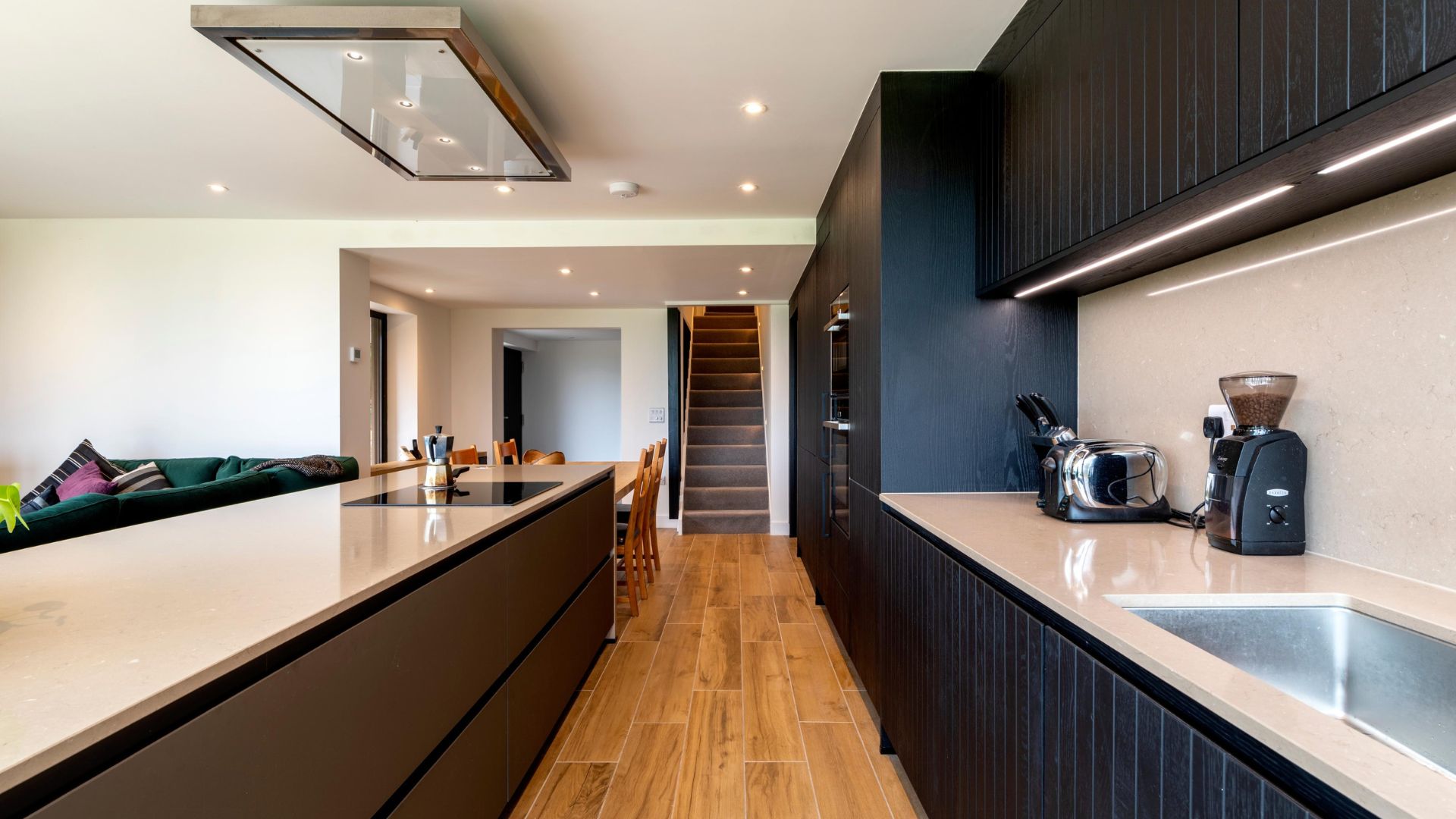
Designing for How a Home Feels
A well-designed home is not defined by the number of rooms it contains, but by how those spaces are experienced.
Light arriving at the right point in the day. A natural progression from one space to the next. A sense of balance between openness and enclosure.
These qualities begin with spatial planning, but they are reinforced through the detail and quality of the interior. The way materials meet, the restraint in finishes, the precision of bespoke elements - all contribute to how a space is perceived and used.
During the early stages of a project, understanding how a client wants to live allows these relationships to be defined with clarity - not just which rooms are required, but how they connect, how they are used and how they support daily life.
Interior design decisions are not applied afterwards, but developed in parallel, ensuring a consistency that allows the home to feel calm, cohesive and well considered.
The result is a home that feels thoughtfully designed, rather than simply complete.
.jpg)
Quality of Space Over Quantity
There is often a tendency to prioritise additional rooms or increased area.
But more space does not always result in a better home.
In many cases, it introduces complexity - more circulation, more transitions and more opportunity for spaces to feel disconnected from one another.
At Kimble Roden, this often means focusing on proportion and purpose rather than quantity - ensuring each space earns its place within the plan and contributes to the overall experience of the home.
This extends beyond layout. The quality of the interior - from the scale of openings to the depth of reveals, from the selection of materials to the integration of storage and joinery - plays a defining role in how successful a space feels.
When this is done well, the architecture becomes more efficient and the home feels more coherent as a result.
.jpg)
Connection, Light and Outlook
How a home relates to its surroundings plays a significant role in how it is experienced.
A room that captures a view will often feel larger than one that does not. Light can extend the perception of space beyond physical boundaries. A visual connection to the outside introduces depth, even within more contained areas.
These relationships are considered early, as part of the overall design strategy rather than something addressed later.
Orientation, openings and the positioning of key spaces are used to shape how the home engages with its setting.
Internally, this is supported by a carefully considered palette and material continuity, allowing spaces to feel connected rather than fragmented.
The result is not necessarily a larger home, but one that feels more open, more connected and more generous in its proportions.
.jpg)
Closing Thoughts
Beyond square footage, architecture becomes less about measurement and more about experience.
At Kimble Roden, this is embedded within the design process from the outset - through early-stage planning, spatial clarity and a considered approach to both architecture and interiors.
The result is not simply a larger home.
It is one that feels more generous, more connected and more carefully designed in both its structure and its detail.
And it is this shift in focus - from size to design quality and experience - that allows a home to truly feel complete.
If you would like to discuss your project with us, please call 01625 402442 or email us to arrange a free initial consultation.
A Vision Inspired by Outstanding Design

.jpg)

-p-800.jpg)


